Removing Heavy Metals with Iron(III) Chloride: What Does the Latest Research Say?
By فريق Egy Chem HubUpdated October 24, 2026
There is no single answer to the question: Does ferric chloride (scientifically known as iron(III) chloride) remove heavy metals? The effectiveness of heavy metal removal with ferric chloride depends on the metal, its chemical form, the pH, and the composition of the water. This article presents findings published between 2023 and 2026, along with older references explaining the mechanism, and attributes each figure to its respective study.
This article provides general information and is not a dosage recommendation. Furthermore, Egy Chem Hub does not have test data for its product regarding metal removal; therefore, no removal percentage is attributed to it here.
Quick Summary
- Iron (III) dissociates into iron (III) hydroxide flocs, and the metals are removed by adsorption, associated precipitation, and entrapment within the flocs.
- Arsenic(V) (As(V)) is the best documented: removal rates exceeding 90% are reported at a pH close to neutral. Arsenic(III) (As(III)), however, is more challenging.
- Copper, nickel, and zinc generally require an alkaline pH, where the effect of iron is combined with that of hydroxide precipitation. Chromium(VI) (Cr(VI)) is usually reduced first.
- Limitations: Competing ions, sludge, residual iron and chloride, and coagulant impurities.
- The optimal dosage is determined by a pot test using actual water, not literature values.
How Are Metals Removed?
When the solution is added to water, the iron(III) ion hydrolyzes, forming iron(III) hydroxide (Fe(OH)₃) in the form of flocs. Three mechanisms are involved:
- Adsorption: Metal ions, or anions carrying them such as arsenates, adhere to the surface of the flocs. A summary by the U.S. Environmental Protection Agency (EPA, 2000) suggested that adsorption and co-precipitation are the primary mechanisms for pentavalent arsenic, a conclusion supported by studies by Inam et al. (2021).
- Co-precipitation: The metal is trapped during floc formation or combines with it to form a sparingly soluble compound.
- Sweep floc: At higher doses, flocs trap metal-bearing particles and colloids, according to the Australian Drinking Water Guidelines (NHMRC).
As for cations, their adsorption onto iron(III) hydroxide increases with rising pH: copper and lead (Swallow et al., 1980), and zinc and cadmium (Roberts, 1981; note that cadmium requires a higher pH than zinc to reach half the adsorption rate).
What’s New in Research
| Study | Water and Metal | Findings | Note |
|---|---|---|---|
| Ibrahimi et al. (2026), PLoS One | Electroplating facility in Tunisia, 24 weeks; chromium(III) 70–132 and nickel 33–92 mg/L | Iron(III) chloride (0.864 kg/m³) was compared with PAC and lime. With lime: over 99% chromium and approximately 97% nickel, and a chemical cost of 0.134 euros/m³ compared to 0.432 with iron(III) chloride. Residual peaks with iron(III) chloride in the first weeks were 2–2.5 for chromium and 17 mg/L for nickel | Operational comparison at a single site; not a controlled experiment |
| Boguniewicz-Zabłocka et al. (2026), Processes | Real electroplating wastewater: nickel, zinc, copper, and hexavalent chromium | In the laboratory, a ferrous coagulant removed the most chromium, while PAC was best for nickel and zinc. After filtration with activated carbon, the overall efficiency exceeded 90% | The figure refers to the integrated process, not coagulation alone |
| Karakaş and Kızıl (2024), Turkish Journal of Engineering | Actual plating wastewater: 88.67 mg/L copper, 438.10 mg/L nickel, and 3.84 mg/liter | 40% iron(III) chloride solution (approximately 5.8 mL/liter) with sodium hydroxide, lime, and a desiccant: 97–100% copper and nickel, 82–98% by weight | The result is a combination of iron and alkalis (pH up to 12.3); a precipitate of 67 mL per 250 mL was formed |
| Lan et al. (2023), Water | Arsenic 5 mg/L | As(V) was removed within 15 minutes using a dose of 0.25 g/L of iron(III) chloride or aluminum sulfate; aluminum sulfate was not effective for As(III) | in laboratory conditions; source: study abstract |
| Inam et al. (2023), Water | Groundwater containing antimony(III) (100–1,000 micrograms/liter) and tannic acid | At 20–100 mg/liter, the dose was the most influential factor in the removal of antimony and organic carbon, and the sludge volume was 0.45 mL/liter under optimal conditions | Statistical model; Source: Study abstract |
| Gorman et al. (2023), AWWA Water Science | Hexavalent chromium in drinking water | Reduction with iron (II), followed by coagulation and filtration, with excess iron (II) oxidized with hypochlorite prior to filtration | Using iron (II), not iron (III) |
The review by El Ouadrhiri et al. (2025, Processes) reports that heavy metal removal by coagulation and flocculation generally exceeds 90% without specifying a coagulant. A review by Sagar et al. (2026, Urban Science) describes hexavalent chromium as being treated by reduction with iron (II), followed by adsorption and associated precipitation; sludge, residual metals, and cost are cited as recurring issues. We did not find sufficient recent data in open sources on mercury, or on lead and cadmium specifically in combination with iron(III) chloride.
Arsenic: The Clearest Case
The recommended limit in drinking water is 10 micrograms per liter (an interim recommendation from the World Health Organization, which is the maximum mandatory level adopted by the EPA in 2001). The organization lists coagulation and sedimentation among the removal techniques. The EPA summary (2000) cites the following from previous studies:
- A dose of 3–10 mg/liter of iron(III) chloride removed 81–96% of arsenic at a full-scale plant with an input concentration of approximately 2.1 micrograms per liter, compared to 23–71% for alum at a dose of 6–20 milligrams per liter.
- Removal of arsenic pentoxide exceeded 90% at iron(III) chloride doses above 20 mg/L.
- Complete removal of arsenic(III) was not observed in Hering’s (1996) experiments, and the EPA suggests considering its oxidation to arsenic(V) first.
pH Ranges and Dosages
| Target | pH | Dosage | Note |
|---|---|---|---|
| As(V) | Good between 6 and 7; decreases at 8 and above in the studies by Inam (2021) and Amiri (2022); and the EPA cited older studies showing effectiveness up to 7.5–8 | Amiri et al. (2022): 50–200 mg/L for high-arsenic water | Studies are inconsistent above 7 |
| As(III) | Unclear: lowest efficiency near 6 in experiments cited by the EPA, improving between 7 and 10 in Inam (2021) | No complete removal (Hering) | Oxidation first |
| Copper, zinc, cadmium, lead | Adsorption increases with rising pH | From 864 mg/liter (Ibrahimi) to about 8.3 g/liter of solution (Karakaş) in highly loaded industrial wastewater | Alkaline windows specific to each metal |
| Nickel | 8.0–9.5 for the lowest solubility according to Ibrahimi, and 10 or higher according to Karakaş, citing his references | — | Varies with composition and coagulants |
Dosages are published in various units (millimoles/liter, FeCl₃·6H₂O, milligrams of iron, or milliliters of solution); convert them to iron before comparing. As a calculation example (not a recommendation): 10 mg/L of iron is equivalent to approximately 71 to 77 mg/L of a solution containing 13–14% iron (product iron content based on TDS).
Practical Limitations
- Competing ions: Phosphate, silica, sulfate, and humic substances reduce arsenic adsorption (Inam et al., 2021, and EPA summary). Chelating agents such as EDTA keep a portion of the metals dissolved (Ibrahimi et al.).
- Sludge: Each milligram of iron yields up to approximately 1.9 milligrams of dry iron(III) hydroxide (calculated from a molecular mass of 106.87 and an atomic mass of 55.845). The sludge is loaded with metals, and Karakaş and Kızıl describe it as difficult to dispose of. The EPA reported that sludge from two arsenic removal plants was not classified as hazardous in the TCLP test; however, this finding is not generalizable.
- Residual iron: The aesthetic limit for iron in drinking water is 0.3 mg/L according to the EPA and Australian guidelines, though this is not mandatory. The NHMRC notes that iron (II) in the product reduces efficacy and may leach soluble iron, causing “red water.”
- Chloride: Added along with iron(III) chloride. Chloride levels in treated water at the Ibrahimi site were reduced by about half when lime was used as a substitute.
- Coagulant impurities: Iron products may contain traces of metals (the NHMRC has provided a list of these), so a batch analysis certificate is required, especially for drinking water.
- True water: Ibrahimi warns that synthetic water overestimates performance, and part of the Inam (2021) results was conducted in deionized water.
Brief Comparison with Alum and Lime
- Alum: Iron(III) chloride outperformed alum for arsenic in the EPA summary, and the EPA prefers iron at a pH above 7.6 or in the presence of As(III). A separate article on the website provides a detailed comparison between the two coagulants.
- Lime: It relies on hydroxide precipitation at alkaline pH and does not add chloride. In Ibrahimi’s study, it was chemically cheaper and more stable, but this was a single case. Iron(III) chloride, on the other hand, produces a floc that binds anions such as arsenic near neutrality.
- Some plants combine the two, as in the cases of Karakaş and Kızıl: iron(III) for flocculation, and lime and soda ash for pH adjustment.
40% Ferric Chloride Solution from Egy Chem Hub
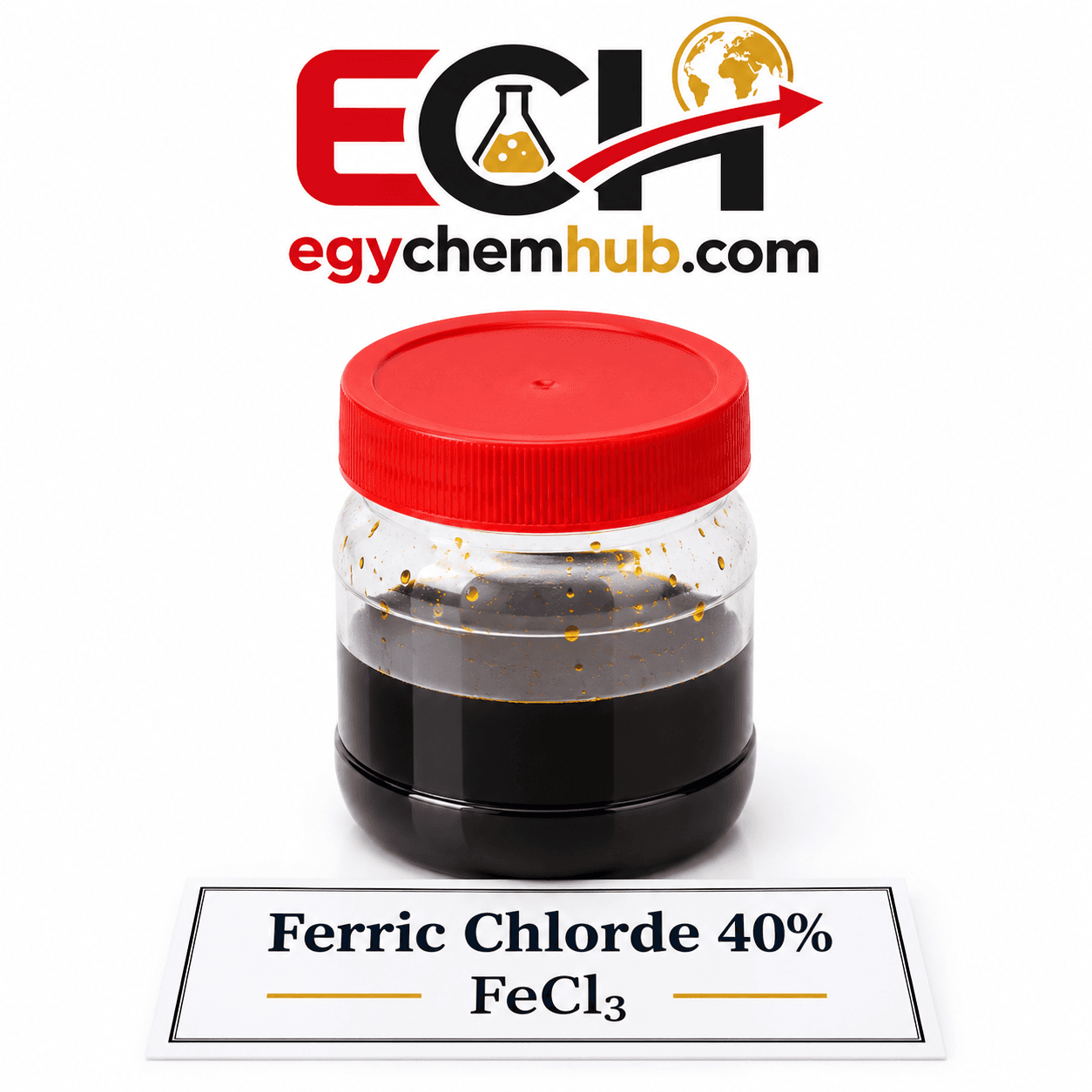
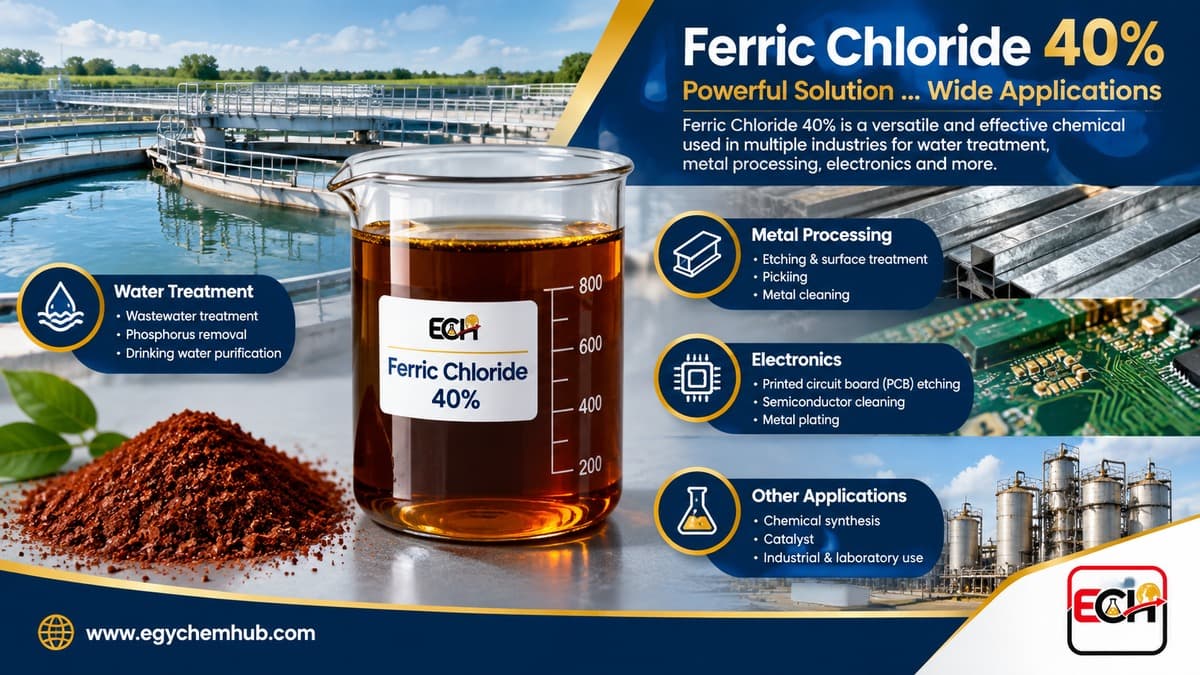
Egy Chem Hub supplies a 40% ferric chloride solution (Ferric Chloride Solution 40%, trade name ECH-FR4014). The formula FeCl₃ refers to the anhydrous compound, while the product is a reddish-brown aqueous solution. The Technical Data Sheet (TDS) states:
- Concentration up to 40% (±2%) by weight, iron 13–14%, ferrous iron up to 1%, free acidity up to 1%, specific gravity 1.42 (±0.02) at 20 °C, and complete solubility in water.
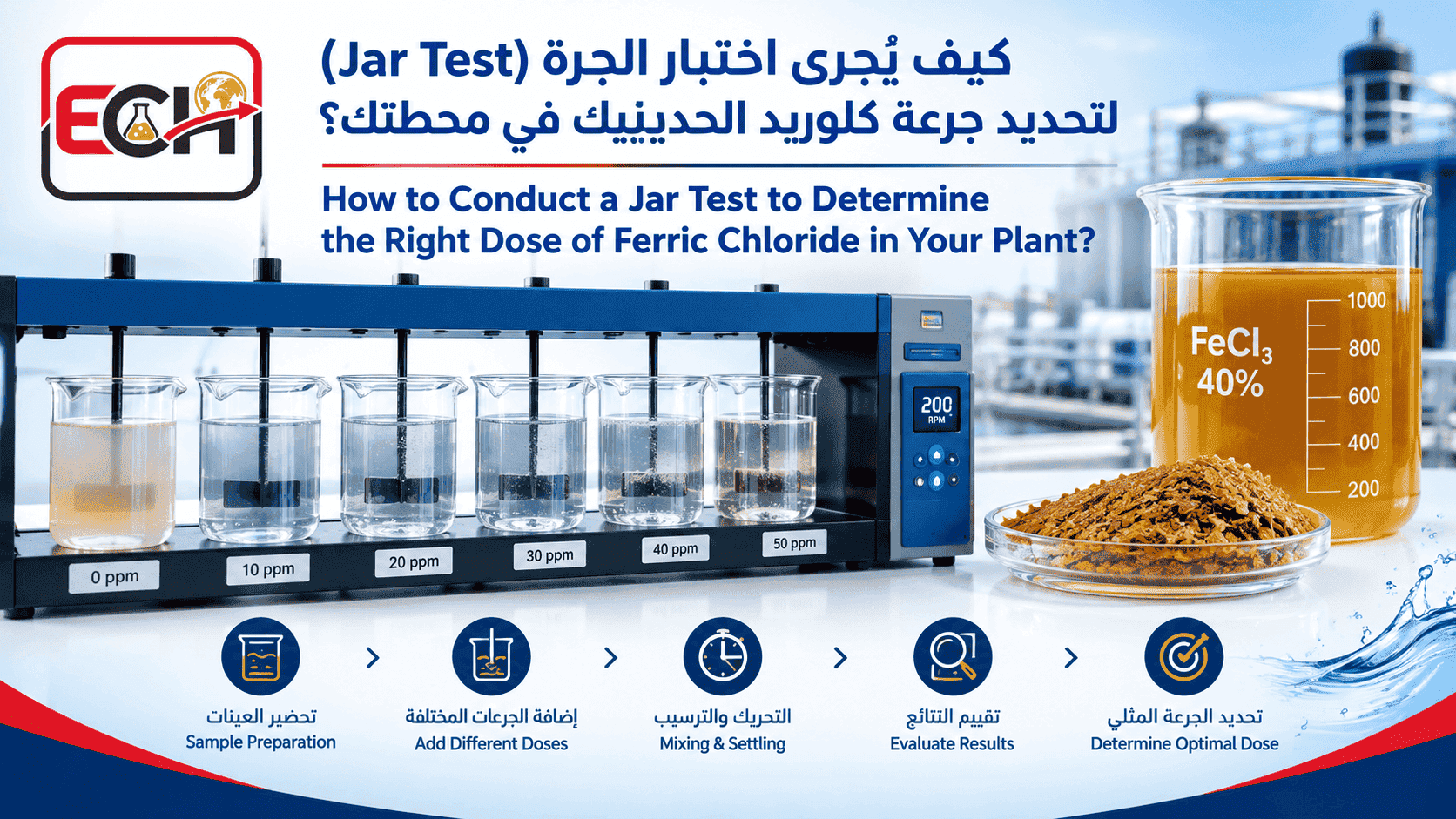
- Optimal dosage determined by pot test; may be injected as a concentrate or in diluted form.
- Packaging: 280 kg HDPE drums, 1,400 kg IBC tanks, and in bulk. Origin: Egypt; shelf life: 12 months; minimum order: one drum.
- The product is manufactured at an NSF-listed facility in accordance with NSF/ANSI/CAN 60 for coagulation and flocculation in drinking water, with a maximum registered usage limit of 100 mg/L.
What We Do Not Provide: The TDS lists applications for coagulation and clarification of drinking water, process water, and wastewater; it does not include metal removal results. Therefore, we do not provide a removal rate or dosage for the product. The TDS and SDS are available upon request.
Safety: The Safety Data Sheet (Version 2) assigns the solution a provisional precautionary classification: May be corrosive to metals (H290), harmful if swallowed (H302), causes severe skin burns and eye damage (H314), and serious eye damage (H318). Its pH is less than 1. It must not be stored with metals, alkalis, or reducing agents; therefore, the lime and soda lines are separated from the solution line.
Frequently Asked Questions
Does iron(III) chloride remove all heavy metals with the same efficiency? No. Efficiency depends on the metal and its valence state (e.g., As(III) vs. As(V), Cr(VI) vs. Cr(III)), as well as pH, competing ions, and chelating agents.
What is the appropriate pH? It varies. Arsenic(V) is removed well near pH 6–7 in several studies, cations require a higher pH, and the optimal pH range varies even for nickel. Therefore, the titration is performed over a range of values rather than a single value.
Does the Egy Chem Hub solution achieve a specific removal rate? We do not have published test data for this product regarding metal removal, so we do not specify a removal rate or dosage. The dosage and the ability to meet discharge limits are determined by conducting a trial on your water, along with laboratory analysis of metals before and after treatment.
What about the resulting sludge? It contains the removed metals; its composition is analyzed and managed in accordance with local regulations, and it is not considered hazardous based on the EPA criteria mentioned.
Contact Us
To request a quote or technical specifications for a 40% ferric chloride (Fe(III)Cl₃) solution, contact the Egy Chem Hub team and include the following information: Target metals, their concentrations, and chemical formulas; pH and alkalinity; competing ions; and the required discharge limit.