Ferric Chloride 40%: Properties and Industrial and Environmental Uses
Introduction
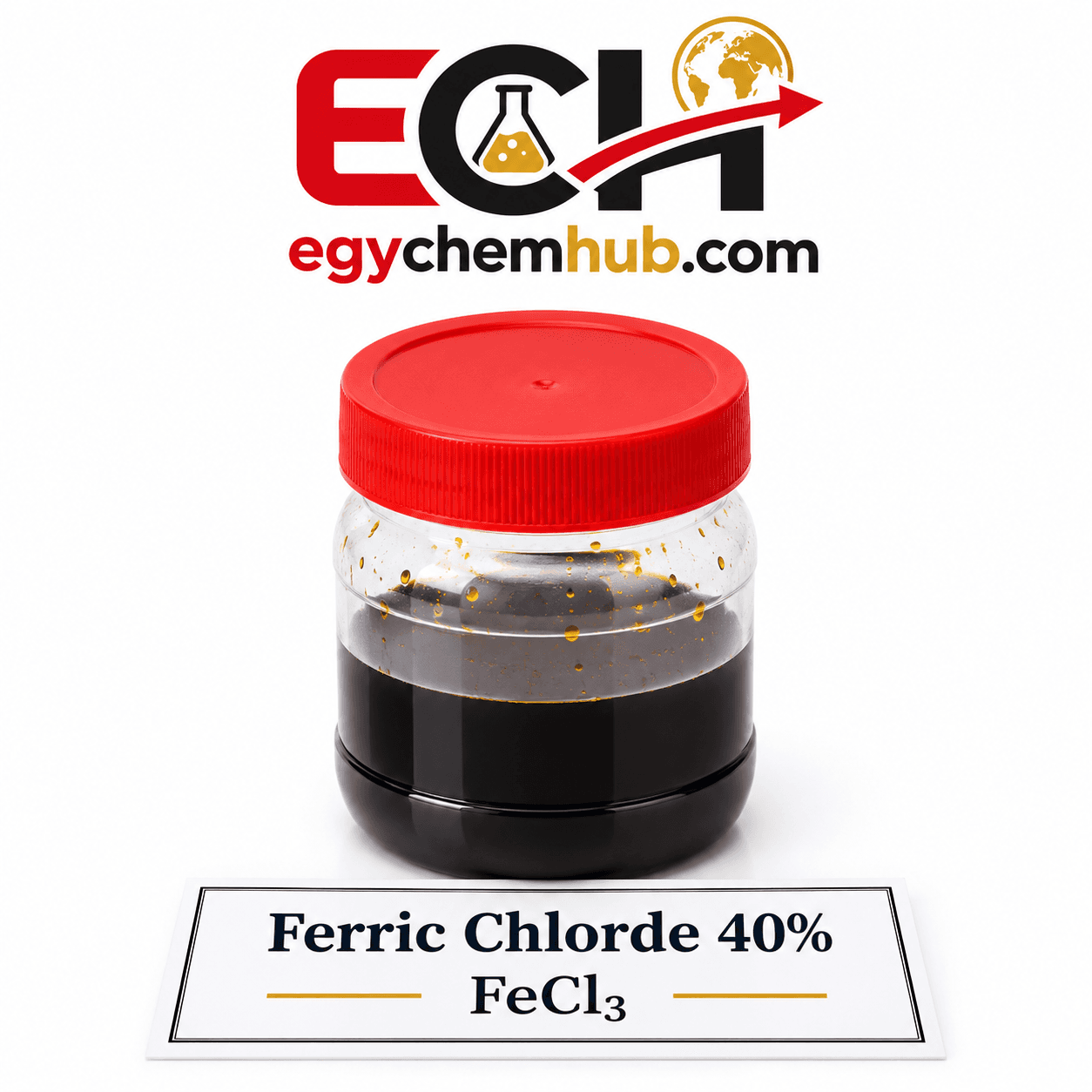
Ferric chloride is one of the most widely used inorganic chemical compounds in the world, and its chemical formula is FeCl₃. This compound is commercially available as a concentrated aqueous solution with a concentration ranging from 30% to 42%, with the 40% concentration being the most common commercial form. The solution is characterized by its dark brown or dark red color, its highly acidic nature, and its corrosive effect on most metals.
The importance of this compound lies in its exceptional ability to act as a flocculant and coagulant, making it an effective tool for separating impurities and contaminants from aqueous solutions. Annual global production is estimated at approximately 2 million metric tons, most of which goes to the water and wastewater treatment and electronics sectors, in addition to various other industrial applications.
What is ferric chloride 40%?
Ferric chloride is an ionic compound consisting of one ferric ion (Fe³⁺) and three chloride ions (Cl⁻), with a molecular weight of 162.2 g/mol in its anhydrous form. When dissolved in water, it reacts rapidly with the natural alkalis present in the water to form ferric hydroxide Fe(OH)₃, an insoluble compound that precipitates as flocs that trap suspended particles and impurities.
Physical and Chemical Properties of the 40% Solution
| Property | Approximate Value |
|---|---|
| Appearance | Thick, dark brown/dark red liquid |
| FeCl₃ concentration | 40% by weight |
| Iron (Fe) content | Approximately 13–14% |
| Specific Gravity | Approximately 1.42–1.45 at 20°C |
| pH | Less than 1 (highly acidic) |
| Freezing point | Approximately −25°C |
| Solubility in water | 74.4 g/100 mL at 0°C — 535.7 g/100 mL at 100°C |
| Corrosiveness | Highly corrosive to metals, including stainless steel |
Due to these properties, the storage and transport of the solution require the use of special materials such as fiberglass-reinforced plastic (FRP) , polyethylene, polypropylene, or rubber-lined steel.
Mechanism of Action
The effectiveness of ferric chloride relies on three complementary mechanisms:
- Charge neutralization: The Fe³⁺ ion carries a high positive charge that neutralizes the negative charges on the surface of suspended particles, preventing them from repelling each other.
- Coagulation and flocculation: The neutralized particles aggregate to form larger, heavier flocs that can be settled or separated by filtration.
- Chemical precipitation: Fe³⁺ reacts with phosphates and sulfides to form insoluble compounds (such as iron phosphate) that are removed with the sludge.
The most important advantage of ferric chloride is its ability to work effectively across a wide range of pH levels (pH 4–11), giving it far greater flexibility than many alternative chemicals.
Main Uses
1. Drinking Water and Wastewater Treatment
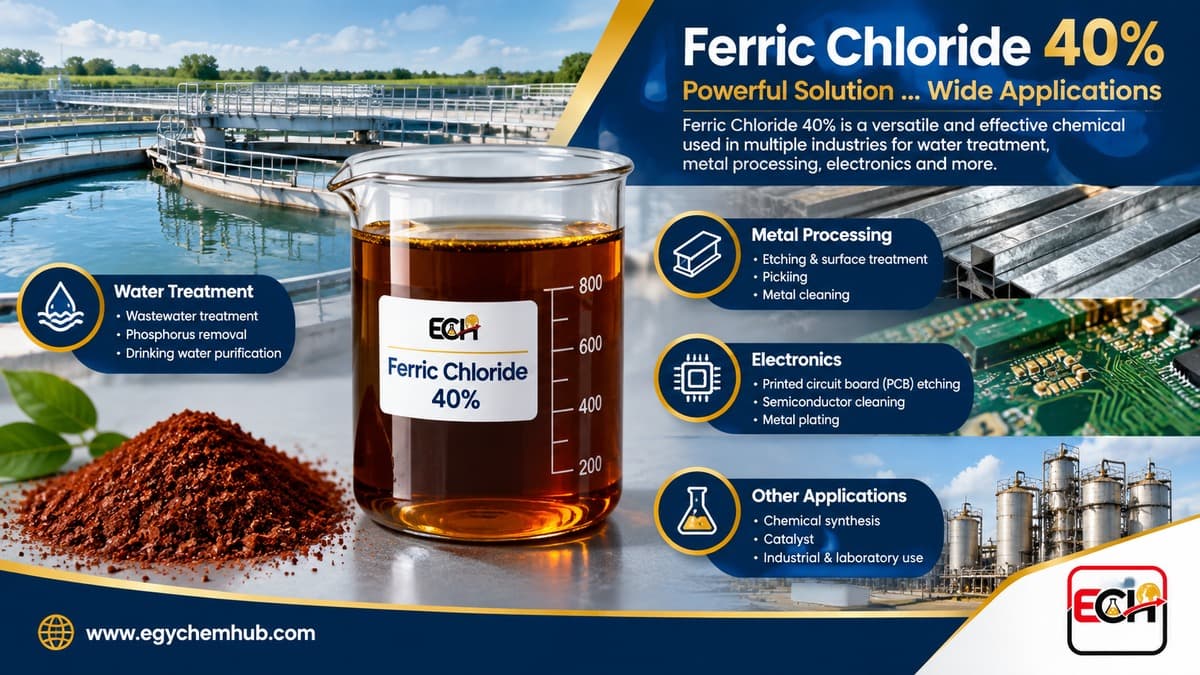
This sector is the largest consumer of ferric chloride globally, accounting for more than 80% of production. It is used as a primary coagulant in drinking water treatment plants, where it is highly effective at removing:
- Turbidity and suspended solids
- Natural organic matter (NOM) and disinfectant precursors
- Microorganisms and algae
- Phosphorus and sulfides
- Heavy metals (nickel, chromium, cadmium, copper, lead, zinc)
Performance Data from Applied Studies
| Dosage (FeCl₃ 40%) | Removal Efficiency Achieved |
|---|---|
| 120 mg/L | 92% of COD · 96% of nitrate · 88% of phenol |
| 160 mg/L | 98% of turbidity · 61% of ammonium ions |
2. Struvite Control and Sludge Dewatering
- Struvite Control: Prevents the formation of magnesium ammonium phosphate crystals that cause blockages in sewer pipes and facilities.
- Sludge Dewatering: Improves the dewatering process of sludge, reducing its volume and disposal costs.
- Odor Control: Prevents the formation of hydrogen sulfide (H₂S) gas, which is responsible for foul odors and corrosion.
3. Metal Etching and Printed Circuit Board Manufacturing
40% ferric chloride is used as an etchant in the manufacture of printed circuit boards (PCBs) and microelectronic components, and has replaced nitric acid in precision etching processes due to its ability to produce sharp, precise vertical lines.
The etching mechanism relies on the oxidation of metallic copper by ferric iron to form soluble copper ions, which removes unprotected layers and exposes the desired design. It is used in:
- The manufacture of printed circuit boards
- The production of cathode-ray tube masks
- The etching of lead frames in the semiconductor industry
- Artistic and decorative etching on copper, steel, and aluminum
It is also used in the preparation of “Edinburgh etching” (a mixture with citric acid), which provides faster etching of brass and copper while reducing deposit buildup in fine grooves.
4. Batteries and Energy Storage
- Zinc-ferric chloride batteries: Acts as an active cathode in inexpensive, environmentally friendly batteries with stable discharge characteristics.
- Lithium-ion Battery Recycling: It is used as a leaching agent to extract cobalt, nickel, copper, and manganese from spent batteries.
5. Dyes and Chemical Catalysts
Ferric chloride reacts with ferricyanide to produce Prussian Blue, which is used in inks and dyes. It also acts as a catalyst in the production of ethylene dichloride, an intermediate compound in the manufacture of polyvinyl chloride (PVC).
6. Textile Industry
It is used as an oxidizing agent and fixative for indigo dye, which helps set the color on fabrics and improve its fastness.
7. Biogas Production
It is added in biogas plants to improve gas quality by reducing hydrogen sulfide, which causes corrosion and odors.
8. Mining and Metal Extraction
It is used as a leaching agent to extract silver and copper from ores, as well as to remove chromium from plastic parts (a dechroming process).
9. Medical and Pharmaceutical Uses
Ferric compounds are used as astringents and hemostatic agents, as they help stop bleeding from small blood vessels by constricting the vessels and accelerating clot formation. This is particularly evident in dentistry and dermatology, in addition to the use of diluted solutions in the treatment of iron-deficiency anemia.
Summary Table: Uses by Sector
| Sector | Application | Function |
|---|---|---|
| Water Treatment | Drinking Water and Wastewater | Flocculation and removal of phosphorus and heavy metals |
| Wastewater | Struvite control | Prevention of scaling and blockages |
| Environment | Sludge dewatering and odor control | Volume reduction and H₂S prevention |
| Electronics | Printed circuit board etching | Dissolution of unprotected copper |
| Energy | Zn-FeCl₃ batteries and recycling | Active cathode / leaching solution |
| Chemicals | Dyes and Catalysts | Production of Prussian Blue and PVC Catalyst |
| Textiles | Dyeing | Oxidizing Agent and Fixative for Indigo |
| Bioenergy | Biogas | Hydrogen Sulfide Removal |
| Mining | Silver and Copper Extraction | Leaching Agent |
| Medicine | Hemostasis | Astringent and Hemostatic Agent |
Dosages and Practical Application
The optimal dosage varies depending on the type and characteristics of the water and is typically determined through a jar test in the laboratory prior to field application. As a general rule:
- Drinking water: 5–30 mg/L of FeCl₃
- Sewage: 20–100 mg/L
- Industrial wastewater: 100–250 mg/L depending on the pollutant load
It is always recommended to start with a low dose and increase it gradually, while monitoring residual turbidity and the final pH.
Safety, Storage, and Transportation
Due to the highly acidic nature and corrosive properties of 40% ferric chloride, handling it requires strict precautions:
Personal Protective Equipment
- Chemical-resistant gloves
- Safety goggles or face shield
- Protective clothing and acid-resistant work boots
- Respirator if vapors are likely to be released
Storage
- Store in tightly sealed containers in a cool, dry, well-ventilated area
- Suitable materials: FRP, polyethylene, polypropylene, PVC, rubber-lined steel
- Avoid storing near alkalis, oxidizing agents, or unprotected metals
First Aid
- Skin or eye contact: Immediately flush with copious amounts of water for at least 15 minutes
- Inhalation: Move the affected person to fresh air and seek medical attention
- Ingestion: Do not induce vomiting; seek medical attention immediately
Environmental Challenges and Future Trends
Despite its many benefits, the use of ferric chloride poses some environmental challenges:
- High Alkalinity Consumption: Its acidic nature depletes the natural alkalinity of the water, requiring the addition of alkaline substances to balance the pH after treatment.
- Sludge management: The resulting sludge contains high concentrations of iron, requiring proper management for disposal.
On the other hand, promising trends are emerging:
- Reuse of industrial waste: Utilizing steel pickling liquor, which is rich in ferric chloride, as a low-cost source.
- Clean energy applications: Development of environmentally friendly zinc-ferric chloride batteries.
- Recycling of Strategic Metals: Expanding its use in the recovery of cobalt and lithium from end-of-life batteries.
Frequently Asked Questions
What is the difference between 40% and 42% ferric chloride? The main difference lies in the concentration and iron content; the 42% solution contains a slightly higher percentage of iron and has greater density, and is typically used in applications requiring a smaller dosage. The 40% solution is the most common in water treatment.
Can ferric chloride be used in swimming pools? Yes, it is used in carefully measured doses to clarify the water and precipitate phosphates, but the pH must be precisely controlled, and the recommended doses must not be exceeded.
Is ferric chloride hazardous to health? It is a corrosive substance and is classified as an irritant to the skin, eyes, and respiratory system. Safe handling requires appropriate personal protective equipment and adherence to safety procedures.
How long is the 40% solution stable? Typically 6 to 12 months when properly stored in airtight containers away from direct heat and sunlight.
Can ferric chloride be mixed with polymers? Yes. It is preferable to add the polymer after the solution has been coagulated with iron, mixing first rapidly and then slowly, while avoiding direct mixing at the same injection point.
Is it used in agriculture? It is used in diluted concentrations as a ferric fertilizer to treat leaf yellowing caused by iron deficiency in alkaline soils, but only in carefully measured doses to avoid harming the plants.
Conclusion
Ferric chloride 40% is a versatile chemical compound that plays a pivotal role in environmental protection and water treatment, in addition to its vital role in the electronics, metals, textiles, and battery industries. Its importance lies in its combination of high effectiveness and affordability, making it a preferred choice for a wide range of industrial applications.
With growing environmental awareness and technological advancements, this compound is expected to see new and innovative applications, with a focus on improving handling practices and waste management to ensure safe and sustainable use.