Etching Printed Circuit Boards (PCBs) with Iron(III) Chloride: How Does It Work, and How Are Spent Solutions Managed?
By فريق Egy Chem Hub
Iron(III) chloride (also known scientifically as ferric chloride) is one of the oldest substances used to dissolve unwanted copper from printed circuit boards (PCBs). It remains a simple and inexpensive option for prototyping and occasional use in small workshops. In continuous industrial production, however, factories tend to use copper(II) chloride because it can be regenerated, keeping the etching rate consistent and reducing the cost of disposing of the solution.
This article covers the chemistry of etching, what determines its quality, why the solution is depleted, what can be done with it afterward, and the most important safety precautions.
The Chemistry of Etching
The iron(III) (Fe³⁺) ion in the solution acts as the oxidizing agent. It pulls electrons from metallic copper, causing the copper to dissolve, and iron(III) is reduced to iron(II) (Fe²⁺). The overall equation is:
2FeCl3 + Cu → 2FeCl2 + CuCl2
The formula FeCl₃ refers to the anhydrous compound, but since the etching solution is an aqueous solution, the equation is written in this form for simplicity.
The reaction actually proceeds in several steps. First, copper(I) chloride is formed; then, it is oxidized by additional iron(III) chloride to form copper(II) chloride; and the accumulated copper(II) chloride, in turn, etches the copper:
FeCl3 + Cu → FeCl2 + CuCl
FeCl3 + CuCl → FeCl2 + CuCl2
CuCl2 + Cu → 2CuCl
Therefore, two etchants work together in the tank over time.
Concentration, Temperature, and Agitation
There is no single concentration that works for all etching solutions. Commercial etching product data sheets vary in this regard: one product is supplied ready-to-use without dilution, while another is supplied at full strength (45 degrees Baumé) and diluted by adding 30% water when etching copper. Therefore, the reference should be the product data sheet for the specific product you are using, not a general figure.
As for temperature, two data sheets from different manufacturers agree on an operating range of 35 to 55 °M; one states that heating within this range accelerates etching and warns against exceeding 55 °M, while the other recommends approximately 45 °C in a temperature-controlled bath. The data sheets and instructional materials also recommend agitating the solution over the board or passing air bubbles through it. The rule of thumb: Keep the temperature, agitation, and etching time consistent for each batch, and record the time required to complete the etching.
Undercut and Etch Factor
The solution does not etch downward only; it also erodes the sides of the copper line beneath the resist layer. This is known as an undercut. It is measured by the etch factor, which is the ratio of vertical etching to lateral etching; the higher the etch factor, the closer the line wall is to being vertical. Definitions of the etch factor vary between references and software, so verify the definition before comparing figures between suppliers.
The main factors that increase undercut:
- Excessive etching time: This damages the edges of the traces and pads. In a published example of copper(II) chloride etching, the difference between an under-etched line and an over-etched one was only a few tens of seconds.
- Increased copper thickness: The greater the distance the solution etches, the greater the side etching.
- Poor control of etching conditions: Manufacturing references indicate that controlling the solution chemistry and temperature within narrow ranges limits this effect.
For practical control: Test on a sample piece; rinse the board after etching and inspect it for short circuits or copper residue; and do not etch unnecessarily.
How Does the Solution Deplete?
As the copper dissolves, it consumes iron (III) ions and adds iron (II) and copper to the solution, causing the etching rate to gradually decrease. The depleted solution contains the remaining iron(III) along with iron(II), copper(II), and copper(I) ions.
Mathematically, the overall equation requires two moles of iron(III) chloride for every mole of copper. In terms of molar masses (FeCl₃ is approximately 162.2 g/mol, and copper is 63.546 g/mol), this means approximately 5.1 kg of FeCl₃ per 1 kg of copper. In a 40% by weight solution, each kilogram contains 0.4 kg of FeCl₃ (anhydrous basis), which theoretically corresponds to about 78 g of copper. This is a theoretical limit, not an operational capacity; drilling slows down before reaching it.
We could not find two sources that agree on a single numerical limit for the solution’s copper capacity, so rely on your supplier’s data sheet and your own etching tests. An increase in the time required to etch the same plate is a practical indicator that the solution is nearing depletion.
Options for Regeneration and Copper Recovery
For the solution to become etching-active again, two things are required: removal of the dissolved copper and reoxidation of iron (II) to iron (III). The most prominent methods published in patents and research abstracts:
| Method | Concept | Points to Note |
|---|---|---|
| Electrolytic Recovery | Copper precipitates as a metal on the cathode, and iron (II) is oxidized back to iron (III) at the anode | Chlorine gas may be generated at the anode and must be contained; the equipment is complex |
| Iron displacement | Iron powder or scrap is added to displace the copper, causing the copper to precipitate as a metal | A solution rich in iron (II) remains, which is not suitable as a catalyst unless it is reoxidized |
| Chemical Oxidation of Iron (II) | Conversion to iron (III) using an oxidizing agent such as chlorine | Chlorine is a toxic gas and requires strict safety precautions |
The developers of these systems state that the recovered copper can be sold as scrap depending on its purity. These are the developers’ claims, not independent results; assess feasibility based on your consumption volume before investing in any equipment.
Disposal of Spent Solution
- Do not discharge into sewers: The product safety data sheet and safety data sheets for commercial drilling solutions prohibit discharging the solution into sewers or aquatic environments, as it contains dissolved copper.
- Classification and Regulation: Regulators generally treat these solutions as hazardous waste. For example, the corrosion standard in the U.S. regulations (40 CFR 261.22) states: Aqueous waste with a pH of 2 or less, or 12.5 or greater, is considered hazardous (code D002), as determined by testing a representative sample. In the Basel Convention, List A includes entry A1130: “Spent drilling fluids containing dissolved copper,” and such waste is considered hazardous unless proven otherwise. The same entry appears in European Union Regulation 1013/2006 on shipments of waste.
- Precipitation: Raising the pH causes copper and iron to precipitate as hydroxides, but this produces sludge that is itself treated as waste. Suppliers’ safety data sheets vary: some recommend discharging the supernatant after precipitation, while others prohibit the discharge of any liquid containing copper; the local regulatory authority’s requirements should be consulted.
- Delivery to an Authorized Entity: Safety data sheets and supplier brochures recommend contacting a local hazardous waste disposal company and disposing of the waste in accordance with official regulations.
- Do Not Mix: Do not mix the spent solution with alkaline or reducing wastes.
These guidelines are general and do not constitute legal advice; national and local laws prevail.
Safety During Handling
- Hazard: The solution is highly acidic (pH below 1 in fresh solution, according to our Iron(III) Chloride Solution Safety Data Sheet). The current Safety Data Sheet for this product (Version 2, 12/10/2026) classifies it as follows: May be corrosive to metals (H290), harmful if swallowed (H302), and causes severe skin burns and eye damage (H314), as well as serious eye damage (H318). It is a corrosive substance. Hazard classifications may vary slightly among suppliers; refer to the current safety data sheet for the product you are purchasing.
- Personal Protection: Gloves, protective clothing, and tight-fitting goggles or a face shield.
- Ventilation: Avoid the formation of mist; use adequate ventilation and local exhaust. Spray drilling or air-bubble drilling may generate mist.
- Containers and Metals: Use plastic or glass containers. The solution reacts with metals to produce flammable hydrogen, which can be hazardous when used with aluminum, zinc, and lead.
- Do Not Mix: Reacts with alkalis and reducing agents.
- Stains: Leaves brown stains on skin and surfaces that are difficult to remove.
- First Aid: In case of eye contact, rinse carefully with water for a sufficient amount of time and seek medical attention. In case of skin contact, wash with plenty of water; if swallowed, rinse the mouth and do not induce vomiting.
- Spills: Absorb with an inert material; do not discharge into sewers. Be aware of the risk of slipping.
Notes for the Buyer
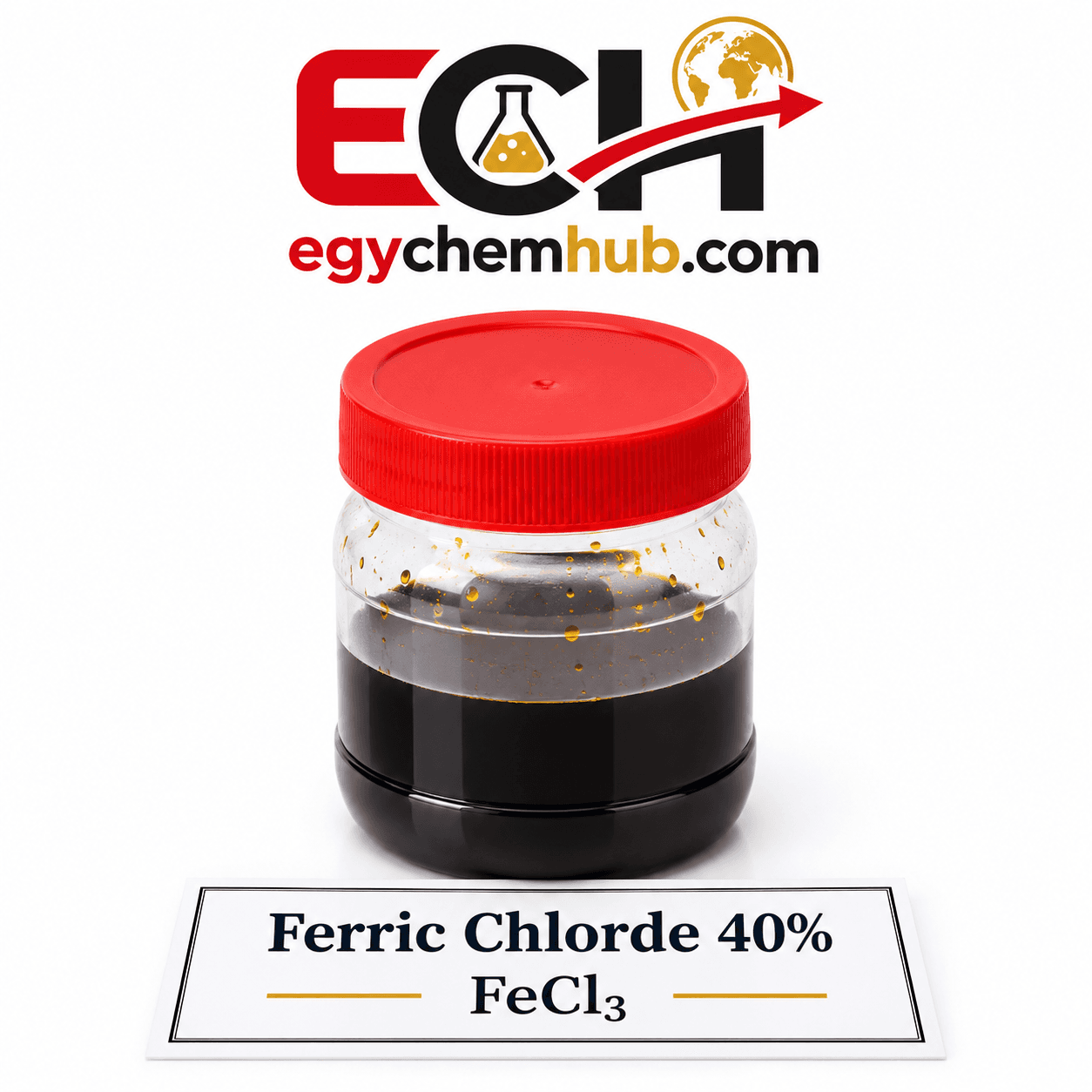
According to data from Egy Chem Hub, this product is suitable for etching printed circuit boards. Copper etching is listed among the applications for 40% ferric chloride solution (Ferric Chloride Solution 40%, trade name ECH-FR4014) on our product page. However, this technical data sheet presents only typical product characteristics and does not include specifications specific to etching. Therefore, before using this product on a specific etching line, contact ECH to request etching specifications: limits for impurities, iron (II), free acidity, and heavy metals, and test it on a test slab under your specific conditions.
Typical properties listed in the technical data sheet: Specific gravity 1.42 (±0.02) at 20 °M, iron content 13–14%, iron (II) maximum 1%, and free acidity maximum 1%. Available in 280 kg HDPE drums, 1,400 kg IBC tanks, and in bulk; minimum order is one drum (280 kg).
Before signing a contract, ask any supplier for:
- Written confirmation that the product is suitable for your drilling operation.
- Impurity limits (iron (II), free acidity, and other metals) compared to your requirements.
- A current Safety Data Sheet (SDS).
- Results of a small-scale trial prior to bulk delivery.
Contact Us
To request a quote or technical specifications, contact the Egy Chem Hub team and include a description of your application and consumption volume so we can help you determine the appropriate product and packaging.