Phosphorus Removal from Wastewater: The Role of Iron(III) Chloride
By فريق Egy Chem Hub
Phosphorus is an essential element for living organisms, but when it enters water bodies in excessive amounts, it disrupts their balance. For this reason, municipal and industrial wastewater treatment plants are required to reduce phosphorus levels before discharge. Chemical precipitation using iron salts is one of the most commonly used methods to achieve this, and the best-known of these salts is iron(III) chloride (scientifically known as ferric chloride).
This article discusses the operational rationale for phosphorus removal using iron(III) chloride, to help operators and engineers understand the dosing process prior to potting tests and dose estimation. As for the properties of the substance itself and its comparison with alum, there are two separate articles on the website.
Why Is Phosphorus Regulated?
Eutrophication is the enrichment of water with nutrients, particularly nitrogen and phosphorus compounds, causing algae and aquatic plants to grow rapidly, which disrupts the balance of aquatic life and water quality. Dense algal blooms lead to a decline in the food and habitat available to aquatic organisms. When the algae die and decompose, dissolved oxygen levels drop, which can result in fish kills.
Therefore, legislation sets limits on phosphorus discharge. As an example of how these limits are formulated, the European Directive on Urban Wastewater Treatment (91/271/EEC) requires that, for discharges into areas sensitive to eutrophication, one or both of the following conditions be met, depending on local circumstances: a maximum total phosphorus concentration of 2 mg/L for treatment plants serving between 10,000 and 100,000 population equivalents, and 1 mg/liter for those serving more than 100,000, or a reduction rate of at least 80%. Limits vary from country to country and from water body to water body; refer to the discharge permit applicable to your location.
How Does Ferric Chloride Remove Phosphorus?
The active agent here is the ferric (III) ion. If ferrous (II) iron is used, it is effective only after it has been oxidized to ferric (III). A simplified description of the reaction is that the iron(III) ion combines with phosphate (dissolved orthophosphate) to form the sparingly soluble iron(III) phosphate (FePO₄), which is then removed by precipitation or filtration. This equation assumes that each mole of iron removes one mole of phosphorus.
However, the reality is more complex. The iron(III) ion simultaneously undergoes hydrolysis to form iron(III) hydroxide flocs, and this hydrolysis competes with the formation of iron(III) phosphate. These flocs capture the phosphate through adsorption and associated precipitation. Studies vary on which of the two pathways predominates under different conditions, but they agree that the added iron is distributed between the two reactions, and that achieving a low residual phosphorus level requires more iron than theoretically calculated. We will return to this point in the section on molar ratio.
Where Is It Added? Three Key Points
| Addition Point | Location | Where Does the Phosphorus Go? | Notes |
|---|---|---|---|
| Pre-precipitation | Raw water before primary precipitation | With primary sludge | Also removes some organic and suspended solids, which may affect the biological nitrogen removal process |
| Simultaneous or Co-precipitation | Aeration tank or upstream of it, or the mixture before the secondary clarifier | With excess sludge | |
| Post-precipitation | Secondary-treated water | In a separate clarifier or filter | Requires additional investment in separation units and is typically used when discharge limits are very low |
There is no single “best” option, and some plants combine more than one method. The choice depends on the required limit, existing units, the sensitivity of the activated sludge, and the sludge disposal method.
Iron-to-Phosphorus Ratio (Fe:P)
The dosage is typically expressed as a molar ratio between iron and the phosphorus to be removed:
- Theoretically, one mole of iron per mole of phosphorus (1:1), or approximately 1.8 grams of iron per gram of phosphorus (calculated from atomic masses: Fe = 55.845 and P = 30.974).
- In practice, the molar ratio typically ranges from 1 to 3 when the residual phosphorus in the secondary water is above 0.5 mg/L, and some references suggest a subsequent addition of about 1.5 to 2.5 moles per mole of phosphorus.
- The lower the target, the higher the ratio. Achieving a very low residual phosphorus level requires doses much higher than the theoretical calculation and may necessitate subsequent filtration.
Illustrative calculation example (not a dosage recommendation): To remove 4 mg/L of phosphorus (in the form of orthophosphate) at a molar ratio of 1.5, approximately 10.8 mg/L of iron is required. Since the iron content in Egy Chem Hub’s 40% iron(III) chloride solution ranges from 13 to 14% by weight, this equates to approximately 77 to 83 grams of the solution per cubic meter. The actual dosage remains subject to a trial run, as the optimal dosage varies with phosphate concentration, pH, and water composition.
To establish a sound basis for the calculation:
- Determine the form of phosphorus to be removed: dissolved orthophosphate or total phosphorus, including particulate phosphorus.
- Use a single unit for comparison: kg of iron, kg of anhydrous FeCl₃, or kg of solution.
- The formula FeCl₃ refers to the anhydrous compound, whereas the commercial product is an aqueous solution; therefore, use the iron content listed in its data sheet.
Alkalinity and pH
Iron(III) chloride consumes the alkalinity of water upon dissolution; the published value ranges from approximately 0.92 to 0.93 mg/L (as CaCO₃) per 1 mg/L of anhydrous FeCl₃. By stoichiometric calculation, this is equivalent to approximately 2.7 mg/L (as CaCO₃) per 1 mg/L of iron. In the previous example (10.8 mg/L iron), this implies a consumption of approximately 29 mg/L of alkalinity, which is considered a rough estimate.
Importance of this at the plant:
- With simultaneous addition, the pH in the bioreactor may drop to a level that microorganisms cannot tolerate; therefore, some laboratory studies have been conducted involving the addition of sodium bicarbonate to compensate for alkalinity.
- Low alkalinity in raw water requires estimating the cost of compensating for it (lime, soda ash, or bicarbonate) as part of the total cost, not just the price of the solution alone.
- The pH is monitored immediately after addition and in the bioreactor, and a determination is made in the flask as to whether adjustment is necessary.
Effect of Addition on Sludge
Any chemical precipitation of phosphorus increases the sludge volume. The added iron is converted to insoluble hydroxide and phosphate, which accumulate in the sludge. To estimate the theoretical upper limit: Each 1 mg of iron yields, in extreme cases, approximately 1.9 mg of iron(III) hydroxide (on a dry basis), a mass that is added to the sludge produced before accounting for the water bound to it.
References indicate that increasing the dose beyond what is required raises both the cost and the amount of sludge. As for the effect of iron on the sludge’s dewaterability, the available references do not agree on a general rule. Therefore, this effect is measured on the plant’s own sludge before determining the addition point.
Brief Comparison with Biological Removal
Enhanced biological phosphorus removal (EBPR) relies on organisms that accumulate phosphate compounds and whose environment alternates between anaerobic and aerobic conditions. In the anaerobic zone, these organisms require an easily consumable carbon source, such as volatile fatty acids, and compete with other organisms for this carbon. Consequently, their performance is influenced by the composition of the wastewater and the operating conditions.
Chemical precipitation, on the other hand, is characterized by its rapid implementation and does not require modification of the biological process; the operator controls the outcome by adjusting the dosage. In contrast, the plant incurs ongoing costs for chemicals and produces more sludge. For this reason, many plants combine the two methods: biological removal of a large portion of the phosphorus, followed by chemical precipitation as a refinement or backup step to achieve the required limit. The trade-off between the two options depends on capital and operating costs, as well as the specific conditions of each plant.
Operational Notes
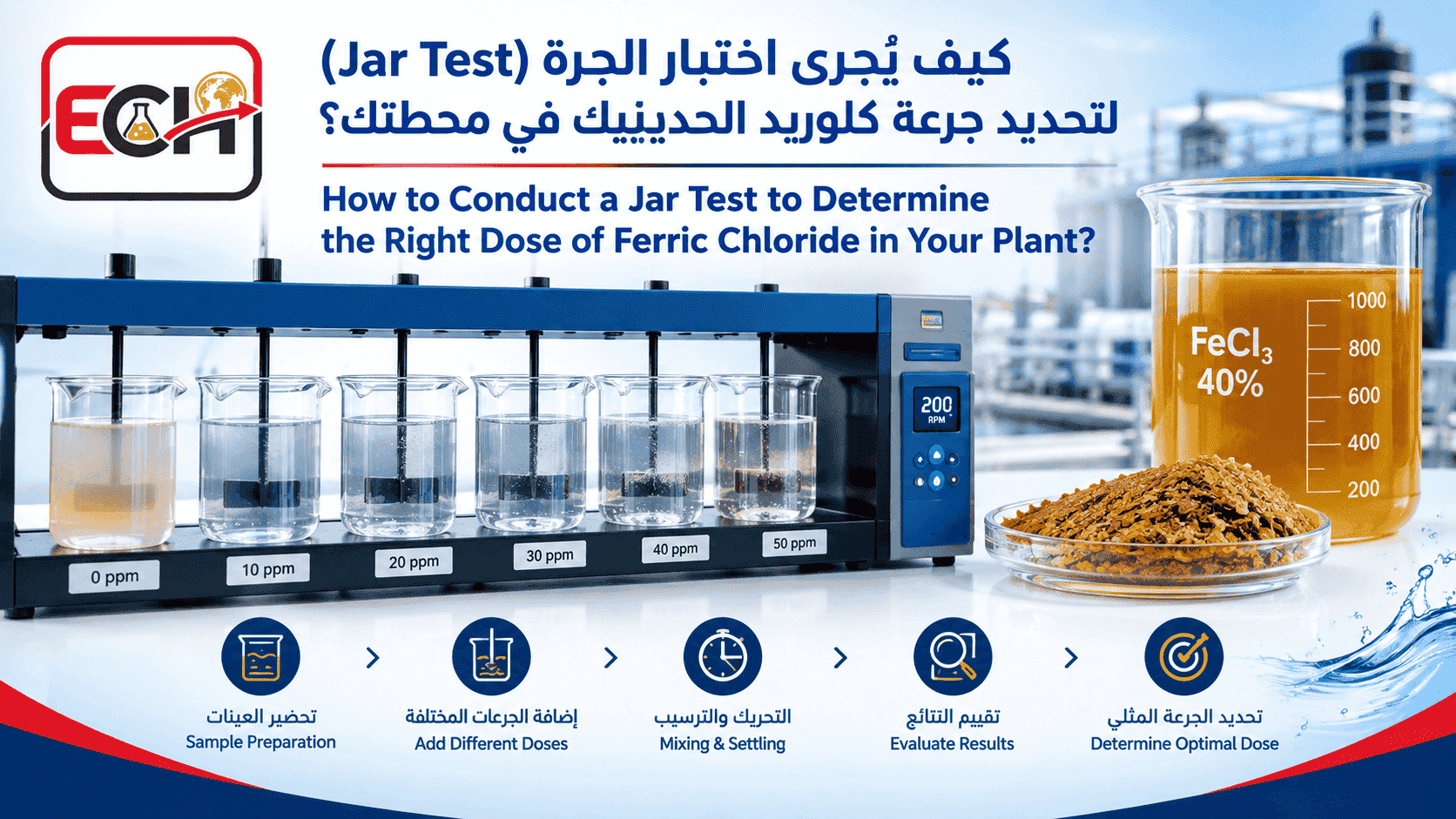
- Dosage testing on actual wastewater is essential for determining the optimal dosage and injection point, and should be repeated whenever the wastewater composition changes.
- Rapid mixing at the injection point: Laboratory studies show that iron added directly to phosphate-containing water is more effective at removing phosphate than pre-prepared iron(III) hydroxide; therefore, the injection point should be designed so that the solution disperses rapidly in the water.
- Avoid overdosing: This increases costs and sludge production and requires reviewing the limits for residual iron in effluent, if specified in the permit.
- Materials and Handling: The solution is acidic and highly corrosive to metals. Suitable non-metallic or lined materials must be used in tanks, pumps, and injection lines. The Safety Data Sheet (SDS) states that the solution must not be stored with metals, alkalis, or reducing agents, and warns that contact with metals such as aluminum and zinc may generate large amounts of hydrogen.
- Safety: Version 2 of the Safety Data Sheet (SDS) for Egy Chem Hub’s 40% iron(III) chloride solution classifies it as potentially corrosive to metals (H290), harmful if swallowed (H302), causing severe skin burns and eye damage (H314), and causing serious eye damage (H318). Gloves, eye and face protection, and protective clothing must be worn, and the Safety Data Sheet must be consulted before handling.
40% Ferric Chloride Solution from Egy Chem Hub
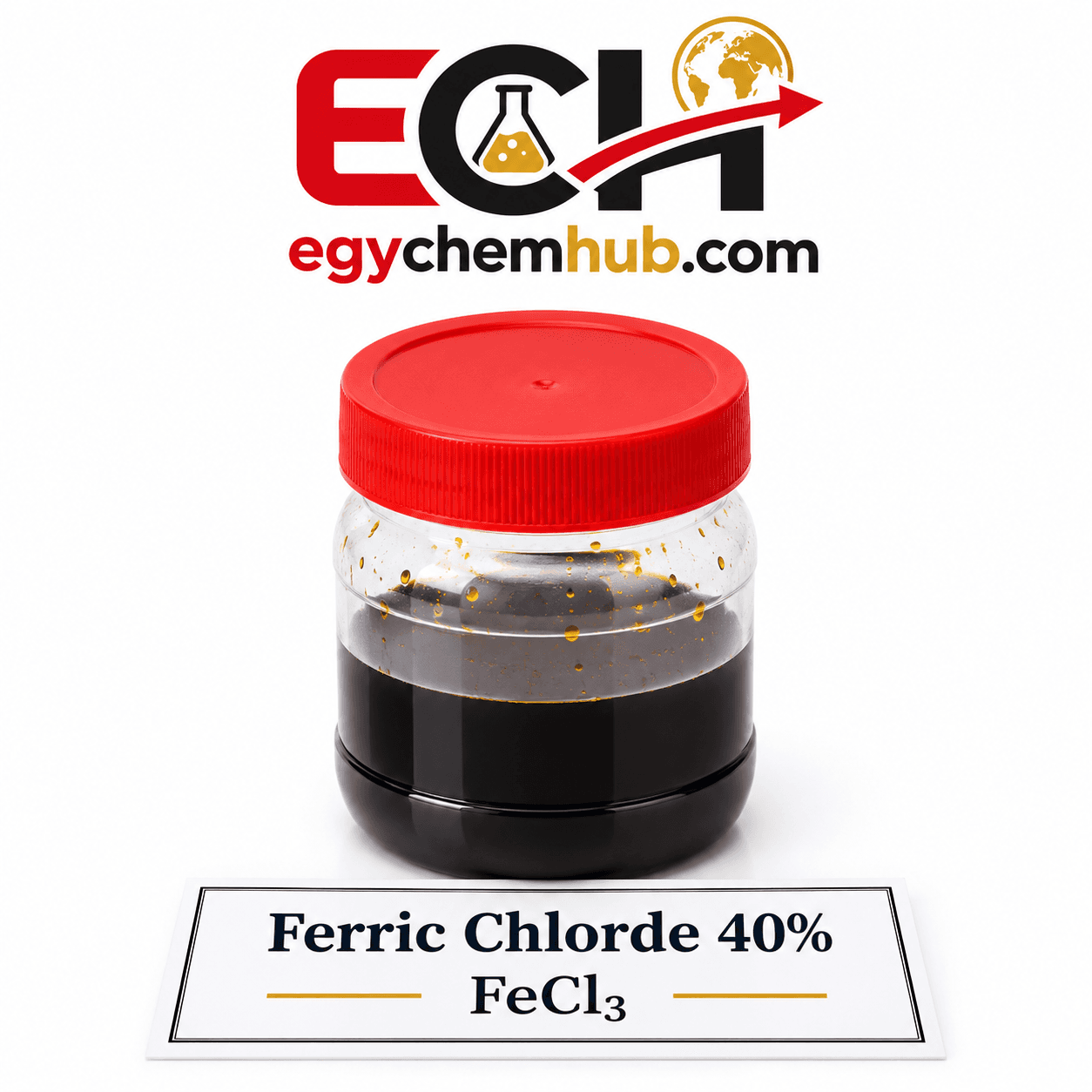
Egy Chem Hub supplies a 40% ferric chloride solution (Ferric Chloride Solution 40%, trade name ECH-FR4014), a reddish-brown aqueous solution used as a coagulant in the treatment of drinking water, process water, and wastewater. The Technical Data Sheet (TDS) lists the following properties:
- Concentration up to 40% (±2%) by weight, or 400 g/kg, which is equivalent to approximately 568 g/liter at a specific gravity of 1.42.
- Iron content: 13 to 14%; ferrous iron: up to 1%; free acidity: up to 1%.
- Specific gravity: 1.42 (±0.02) at 20 °C; completely soluble in water.
- The optimal dosage is determined by a pot test; it can be injected either undiluted or after dilution.
It is packaged in 280-kg HDPE drums and 1,400-kg IBC containers, and is available in bulk. Origin: Egypt; shelf life: 12 months; minimum order: one drum (280 kg). The product is manufactured at an NSF-listed facility in accordance with NSF/ANSI/CAN Standard 60 for coagulation and flocculation applications in drinking water treatment. The maximum usage level listed in the NSF registry is 100 mg/L, calculated on the basis of FeCl₃ (according to data from Egy Chem Hub), for drinking water applications; this value is not used to determine discharge limits. TDS and SDS sheets are available upon request.
Contact Us
To request a quote or technical specifications for a 40% ferric chloride solution, contact the Egy Chem Hub team and include any available data about your water: phosphorus level and form, alkalinity, proposed dosing point, and required discharge limit.