Salt spray test and corrosion resistance standards for zinc laminations
By فريق Egy Chem Hub
Parts drawings and purchase specifications often include a condition such as "no red rust will appear before a certain number of hours of salt spraying." This number is used for acceptance or rejection and for comparing suppliers, but its true meaning is sometimes misunderstood. This article explains what the test actually measures, where it ends, how requirements for zinc foil coatings on fasteners and metal parts are formulated, and how to read the report you receive.
What does the neutral salt spray test measure?
The coated part is exposed in a sealed chamber to a continuous salt mist generated by spraying a sodium chloride solution. The sample is then monitored until corrosion products appear or the required testing period has elapsed. The two most commonly used standards are ISO 9227 (NSS test) and ASTM B117, the latter of which was first published in 1939.
Conditions approved in ISO 9227 for neutral testing:
| Worker | Value |
|---|---|
| Sodium chloride concentration in the collected solution | 50 ± 5 g/L (approximately 5%) |
| PH of the collected solution | From 6.5 to 7.2 |
| Room temperature | 35 ± 2 °C |
| Spray sedimentation rate | From 1.0 to 2.0 ml per hour per 80 cm² |
| Spray pattern | Continuous |
ASTM B117 specifies near-ideal conditions: a 5% sodium chloride solution, pH between 6.5 and 7.2, and a temperature of 35 °C. Because tolerance formulas may differ between the two standards and between versions (for ISO 9227 version 2017 and then version 2022 with the 2024 amendment), the report must state the standard and its version number.
Key point: ISO 9227 only specifies the operating procedure. It does not specify the exposure time for a particular product, nor how to interpret the results; these are left to the product specifications or to the agreement between the buyer and the supplier.
Test limits
- It is not a simulation of reality. It lacks humidity changes, temperature fluctuations, and industrial pollutants, therefore the paint's behavior in testing may differ from its behavior in service.
- A clock in a room is not a clock in the field. The standard itself indicates that there is rarely a direct relationship between salt spray resistance and corrosion resistance in other environments. And "720 hours" cannot be correctly converted into a number of years.
- Its primary purpose is quality control. It is suitable for verifying the consistency of paint quality and process from batch to batch, detecting defects and pores, and its results are characterized by good repeatability. However, ranking different materials or coatings according to their "lifespan" or predicting their longevity is not among its purposes.
This explains how a standard like ISO 10683 can use salt spray hours as acceptance categories: the hours here are a quality limit for a specific coating system tested in the same way, not a promise of service life.
Red rust and white rust: what is recorded?
- White rust: a white powder that is a byproduct of zinc corrosion, primarily composed of zinc oxide and zinc hydroxide. Its appearance indicates that the coating has begun to deteriorate.
- Red rust: a product of corrosion of the base steel (iron oxides). Its appearance indicates that the protective coating has reached the base metal.
In zinc-rich coatings, white rust typically precedes red rust because zinc corrodes before steel. Therefore, the specification should explicitly state which type is intended. ISO 10683 requires that no visible corrosion (red rust) appears in the base metal after the test period. The limits for white rust are not covered by this requirement and may be added in the customer's specifications. Read the specification applicable to your application and do not make assumptions.
How are the requirements for zinc foil coatings determined?
ISO 10683 for fasteners
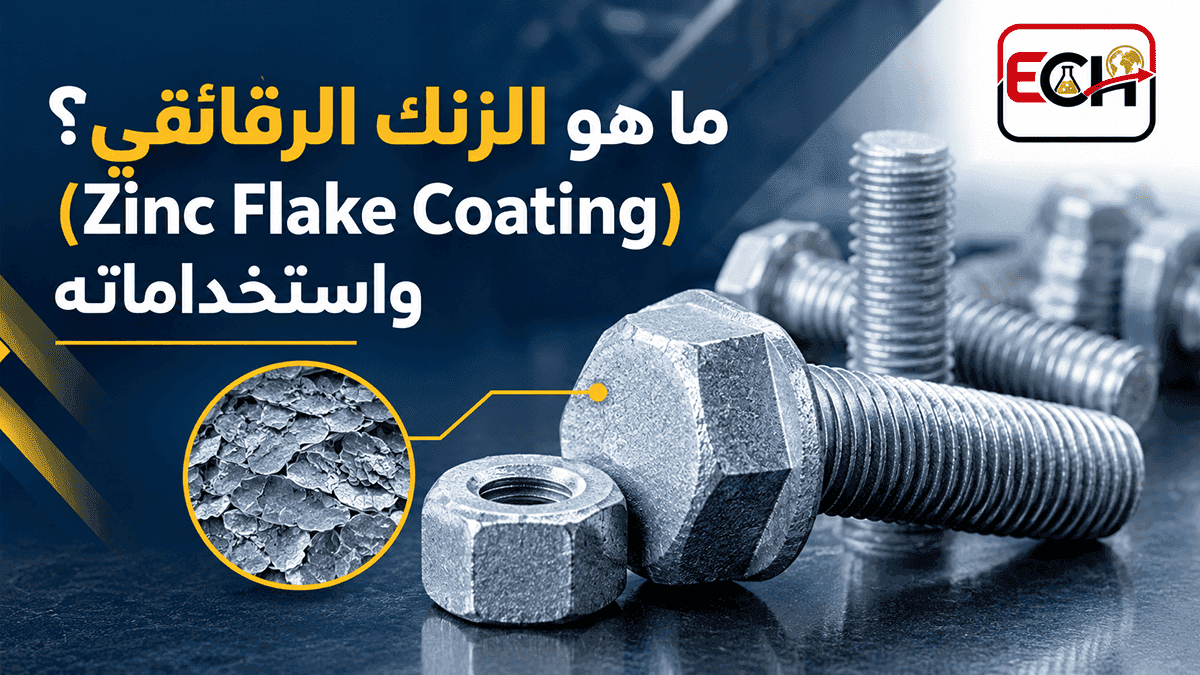
ISO 10683:2018 (3rd edition) covers non-electrolytic zinc lamination systems applied to steel fasteners, whether the system is a base coat only or a base coat with a top coat, and whether or not a lubricant is added. ISO 9227 (NSS) is used to assess corrosion resistance. Requirements are categorized as follows:
| Neutral salt spraying time without red rust | Reference thickness for coating system |
|---|---|
| 240 hours | 4 microns |
| 480 hours | 5 microns |
| 600 hours | 6 microns |
| 720 hours | 8 microns |
| 960 hours | 10 microns |
Important notes on the table:
- The stated thickness is for reference only and includes both the base and top layers. Acceptance is based on corrosion resistance.
- The test is carried out on the stabilizers alone in the “as painted” condition, i.e., before sorting, packing and assembly, and at least 24 hours after painting.
- The standard includes an optional scratch test to measure cathodic protection: the piece is scratched down to the base metal, and then no red rust should appear at the scratch site after 72 hours of salt spray.
- Remember that the standard itself warns that accelerated test results are not directly related to paint behavior in a particular service environment.
Specifications of car companies
Car manufacturers and their suppliers write their own specifications and supply rules, and many of them include their own periodic tests. We do not list specific customer specifications here because we have not verified them with two independent sources; the reference for this information is your customer's approved specification document.
Protecting high-strength stabilizers from hydrogen erosion
ISO 10683 states that the zinc lamination process does not generate hydrogen, therefore the coating is used especially for high-strength fasteners (1000 MPa and above) to avoid internal hydrogen brittleness. This makes it a popular choice for this class of fasteners.
Where do the zinc flakes fall in the test result?
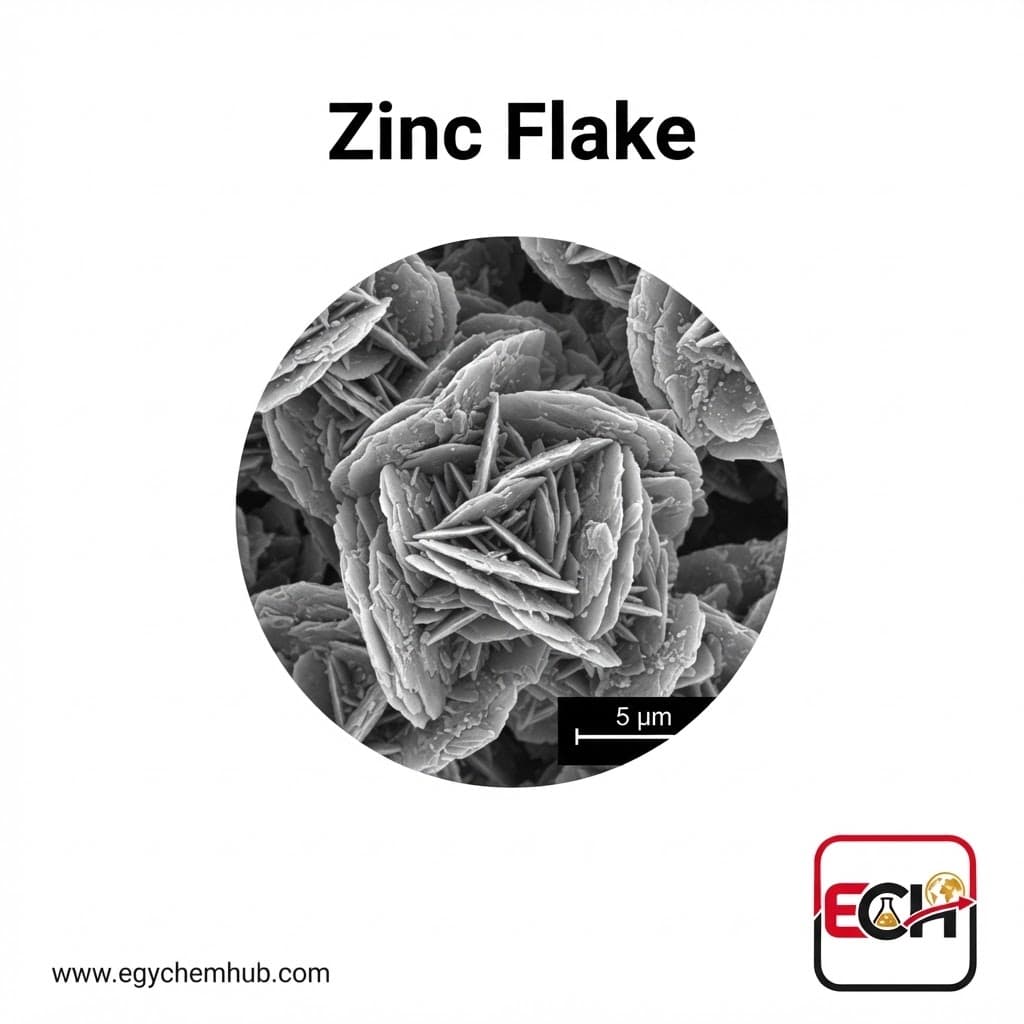
The zinc foil coating consists of zinc foils dispersed in a medium, which are then applied and heat-treated to form an inorganic film electrically conductive enough to provide cathodic protection. The foils are therefore one component of this system, but not the entire system.
What the technical data sheet for Zinc Flake from Egy Chem Hub says
Egy Chem Hub presents zinc flakes as lamellar zinc powder for corrosion-resistant coatings. It is a raw material (metallic pigment) used in coating formulation, not a finished coating. This information is based on the company's Technical Data Sheet (TDS) as of October 11, 2026.
| Property | Value according to TDS |
|---|---|
| Appearance | Gray powder |
| Shape | Flakes |
| Average particle size | 5-10 microns |
| Total zinc | 98% minimum |
| Zinc metal | 94% minimum |
| Remaining on a 325 mesh (45 micron) sieve | Maximum 0.6% |
| Oil absorption | 12-15 grams per 100 grams |
| Humidity | 0.05% maximum |
| Specific gravity | 7.0 – 7.2 |
Packaging options include 25 kg polypropylene bags with an inner lining, or 25 kg metal or plastic drums provided by the customer. Origin: Egypt. Technical data sheets are available upon request. The sheet lists common applications such as corrosion-resistant paints, plating, chemical processes, and powder metallurgy.
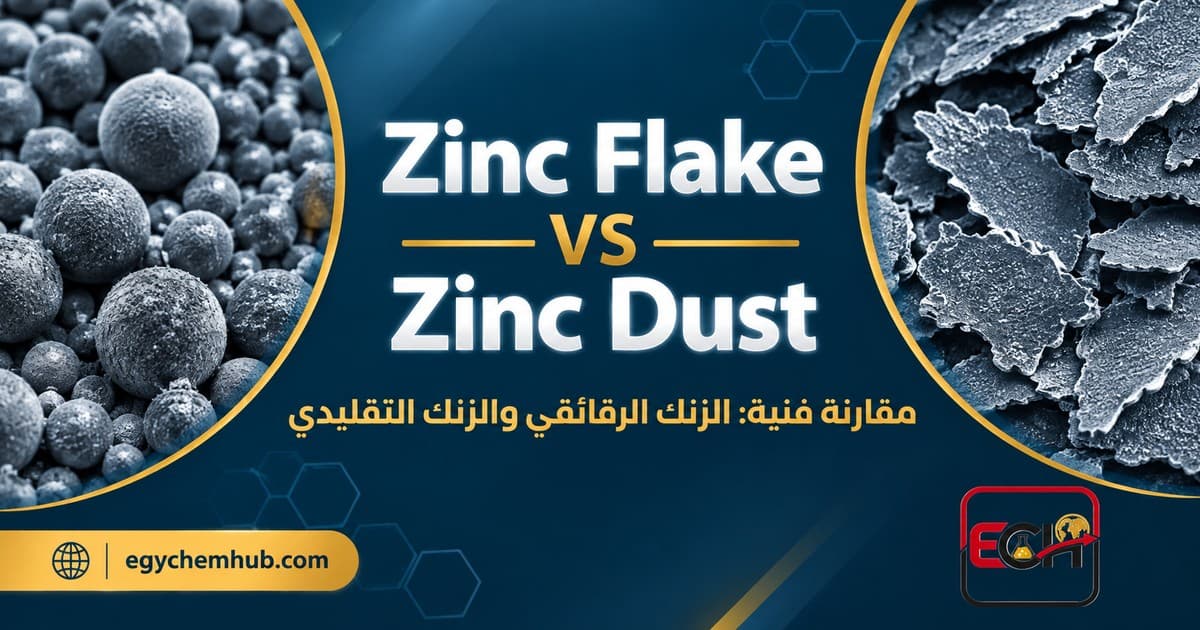
According to the same paper, the lamellar shape allows for greater contact between particles compared to spherical zinc, which improves electrical conductivity and corrosion protection. The paper describes the barrier effect as long-lasting, while the cathodic protection is temporary. These are statements from the company paper and do not represent test results.
Why are chip specifications alone insufficient to predict salt spray hours?
The salt spray result pertains to the entire coating system: the bonding resin and coating composition, the topcoat, the applied thickness, the application and heat-curing conditions, and the condition and surface preparation of the metal substrate—not just the zinc powder alone. Identical flakes may produce different results if the resin, thickness, or degree of curing varies. Therefore, this article does not include any salt spray hours or test results for a single zinc flake product, nor should it be inferred that a particular raw material guarantees a specific number of hours. Such a result should be attributed to a defined and tested coating system and must be accompanied by a report detailing the system components and test conditions.
What data should a paint manufacturer request from a chip supplier?
When evaluating any zinc foil supplier, request the following in writing:
- Technical Data Sheet (TDS) dated for revision, with numerical characteristics: particle size (mean and method of measurement), total zinc and metallic zinc, residue on sieve, oil absorption, moisture, specific gravity and apparent density.
- Limits for impurities (such as iron, lead, cadmium, and zinc oxide) if your specification restricts them.
- Certificate of Analysis (CoA) for each batch, and whether the results are measured on the batch actually supplied.
- The type of surface treatment for the chips, if any, and its compatibility with your resin and solvent or water system.
- Shelf life, storage conditions, and shipment packaging.
- Sample it for testing in your own system, because the paint's performance is determined by testing it completely.
- Any salt spray report (ISO 9227 or ASTM B117) on a coating system made with the material, including system data: resin, thickness, substrate, curing conditions, and laboratory reference. If no report exists, request that it be certified rather than provided in the form of generic figures.
Regular testing: A supplement, not a replacement
Cyclic corrosion tests are designed to closely resemble actual usage conditions by alternating stages of salt spraying, humidity, drying, and sometimes freezing. Well-known examples include:
- GMW14872 (General Motors): Three-stage cycle: Ambient environment at 25 °C with saline spray, then relative humidity close to 100% at 49 °C, then drying with relative humidity less than 30% at 60 °C.
- VDA 233-102: Periodic testing of automotive parts that includes a spraying phase with a 1% salt solution and a freezing phase at −15 °C.
- ISO 11997-1: A specification for paints that includes several cycles in which the stages of salt spraying, drying and moisture alternate.
These tests do not guarantee a "service life": they are still accelerated tests, and a direct correlation with service life is uncertain. Their value lies in their closer approximation of actual operating conditions than continuous spraying, which is why car manufacturers conduct their own periodic tests. Request both tests when the part is critical or in a harsh environment (coastal, de-icing salts, or prolonged outdoor exposure).
How do you read a test report?
Read the report as you would a calibration certificate. This is a process checklist we developed based on the requirements of the two standards:
- Standard and version: ISO 9227 or ASTM B117, and any supplement (such as scratch testing).
- Sample: Were the actual pieces tested in an "as painted" condition or as test plates? What was the time between painting and testing? What was the painting system in detail (base coat only or with a top coat)?
- Fish: The measured value and method of measurement, not just the nominal value.
- Intermediate duration and tests: Actual number of hours, times of testing, and time of appearance of the first white rust and the first red rust, if present.
- Room records: temperature, sedimentation rate, pH and salt content, recorded daily, noting any deviation or interruption.
- Chamber verification: Have periodic checks been carried out with reference samples (such as standard steel strips whose mass loss is measured) to prove that the chamber is operating within its range?
- Photos: Before and after the test, and at the agreed-upon times.
- Laboratory: Laboratory identity and accreditation reference.
What do you ask the supplier?
- What is the standard, version, and acceptance standard (red rust only or white as well), and how many hours are required?
- Does the test cover the entire paint system that will be delivered to you, and at what thickness?
- Were pieces from actual production tested, or just laboratory samples?
- Are there periodic test results (such as GMW14872 or VDA 233-102) if your specification requires them?
- How is paint monitored from batch to batch (thickness, adhesion, and appearance)?
- Are the raw material data (zinc foil specifications and test results for each batch) available to the manufacturer of the coating system? (See detailed list above.)
If you are manufacturing or developing a zinc flake coating system, raw material data is only part of the picture. To request a quote or technical data sheet for zinc flakes, contact the Egy Chem Hub team.