
October 5, 2026
Flake Zinc Powder vs. Conventional Zinc: Why Is Low Density an Advantage Rather Than a Disadvantage?
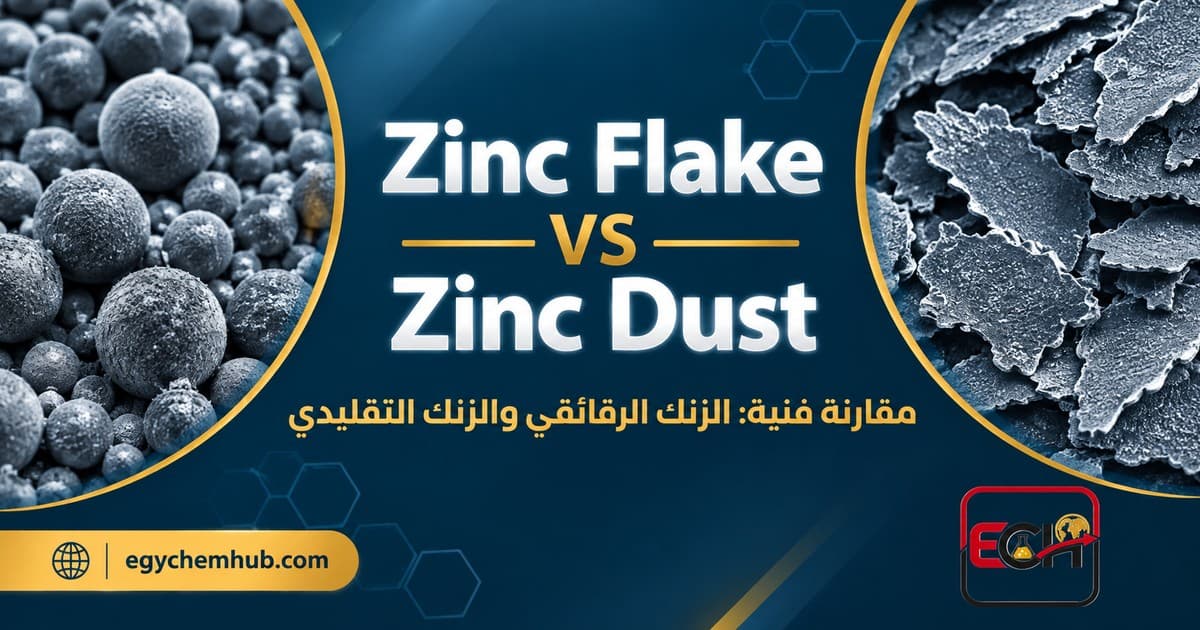
Flake Zinc Powder vs. Conventional Zinc: Why Is Low Density an Advantage Rather Than a Disadvantage?
In the market for industrial and protective coatings, zinc powder is one of the most important active ingredients in rust-protective primers. However, there is a fundamental difference between the two main types of this product that many manufacturers and buyers overlook: the difference between zinc flake (Zinc Flake / Lamellar) and traditional spherical zinc dust. The low bulk density of zinc flake is often cited as a weakness, when in fact it represents a clear competitive advantage.
What is the difference between the two forms?
Zinc flake consists of flat, thin particles that pile up on top of each other in an irregular manner, trapping large air voids between them. This reduces the bulk density to approximately 1.15–1.20 kg/m³, even though the true specific gravity of metallic zinc remains constant at 7.0–7.2.
As for conventional spherical zinc, its round granules pack together very efficiently, filling the voids between them, which raises its bulk density to about 2.5 kg/m³.
This difference in shape is the basis for all the technical and economic differences between the two products.
Dual Protection: Cathodic and Barrier
Zinc generally provides cathodic protection for metal surfaces; it chemically sacrifices itself in place of the iron. However, zinc flake coating adds barrier protection (Barrier Protection) ; the overlapping flakes form a long, winding path that is difficult for water and oxygen molecules to penetrate, as revealed by electron microscope images that clearly show how the flakes form a continuous mechanical shield over the surface.
In contrast, spherical zinc granules rely primarily on cathodic protection alone, without providing the same level of mechanical barrier protection.
Technical Comparison Table
| Property | Lamellar Zinc (Our Product) | Spherical Zinc (Competitor) |
|---|---|---|
| Particle Shape | Lamellar | Spherical / Granular |
| Bulk Density | 1.15–1.20 kg/m³ | ~2.5 kg/m³ |
| Specific Surface Area | High | Low |
| Barrier Protection | Excellent | Limited |
| Cathodic protection | Effective | Effective |
| Required dispersant ratio | About 50–60% lower | Higher |
| Settling in the container | Very low, easy to remix | Higher, risk of clumping |
| Flexibility and edge protection | Better | Average |
| Final surface quality | Smooth and glossy | May be rougher |
| Total formulation cost | Lower | Higher |
Why is low density an advantage rather than a disadvantage?
The crux of the matter is that bulk density is not an absolute measure of quality; rather, it is a direct reflection of particle shape. Since flakes have a higher specific surface area per unit weight, this results in:
First: Savings in dispersing agent
The flakes wet and disperse within the resin naturally and easily, without requiring large amounts of dispersing/wetting agents—which are needed for heavy spherical particles to prevent them from agglomerating and settling. This directly reduces the cost of additives.
Second: Lower Pigment Volume Concentration (PVC)
The same level of protection can be achieved with a lower percentage of zinc in the total paint volume, allowing for an increased binder (resin) content, thereby improving flexibility, edge and corner protection, and the paint’s overcoatability.
Third: Greater Stability in the Container
Heavy spherical zinc tends to settle quickly at the bottom of the container and form a clumped layer that is difficult to remix. Light flakes, on the other hand, remain suspended longer and return to their original state with a simple stir.
Fourth: Lower Total Paint Weight
For every liter of ready-to-use paint, the weight of paint formulated with flake zinc is lower than that of its spherical counterpart, which is an important factor in applications such as suspended structures or ceilings.
Is flake zinc suitable for single-component (1K) paints?
Absolutely. Flake zinc powder is successfully used in:
- Single-component inorganic zinc silicate primers (Ethyl Silicate Self-Cure), which cure by absorbing atmospheric moisture without the need for a separate hardener.
- air-drying zinc alkyd and silicone primers.
- fast-drying zinc vinyl primers (Shop Primers) used in shipbuilding and steel structures.
Low viscosity is particularly important here, because single-component paints are not mixed immediately before use but remain in the container for months; therefore, resistance to settling becomes an essential requirement rather than a luxury.
Comparative Formulation Guide
Formulation of a two-component epoxy primer using flake zinc (Component A**):**
| Component | Weight Percentage % |
|---|---|
| Liquid epoxy resin (EEW ~190) | 14–16% |
| Solvents (xylene / n-butanol) | 8–10% |
| Zinc flake powder | 60–65% |
| Anti-settling agent | 0.2–0.3% |
| Defoamer | 0.1–0.2% |
| Spreader/wetting agent | 0.3 – 0.5% |
Equivalent formulation using conventional spherical zinc (Component A**):**
| Component | Weight % |
|---|---|
| Liquid epoxy resin (EEW ~190) | 10–12% |
| Solvents (xylene / n-butanol) | 6–8% |
| Spherical zinc powder | 70–75% |
| Anti-settling agent (high dose) | 0.8–1.2% |
| Defoamer | 0.1–0.2% |
| Spreader/wetting agent (high dose) | 0.8–1.2% |
The difference is clear: spherular zinc requires a higher loading (70–75% vs. 60–65%) and double the amount of spreading aid to maintain formulation stability, which directly affects the cost and performance of the final coating.
Bottom Line
The low bulk density (1.15–1.20 kg/m³) of flake zinc powder is not a shortcoming in the specifications, but rather the first physical indication of its true advantage. This density results in: superior barrier protection, reduced use of dispersing agents, greater stability in the package, and a lower overall formulation cost—in both single-component and two-component systems.
To inquire about the availability of zinc flake powder manufactured in Egypt and supply options, contact the Egy Chem Hub team via the website.